










When Christopher Moltisanti walks into the dingy apartment and sees a gathering of concerned family, friends, and professional colleagues, he wants no part of the impending intervention. The mafia protege, played unforgettably by Michael Imperioli in HBO’s The Sopranos, spins around to leave – until he’s ordered back in by the boss, Tony Soprano. The assembled gangsters and hangers-on take turns imploring Moltisanti to kick his self-destructive habits. Paulie Walnuts cuts to the chase: “I don’t write nothin’ down, so I’ll keep this short and sweet. You’re weak, you’re out of control, and you’ve become an embarrassment to yourself and everybody else.”
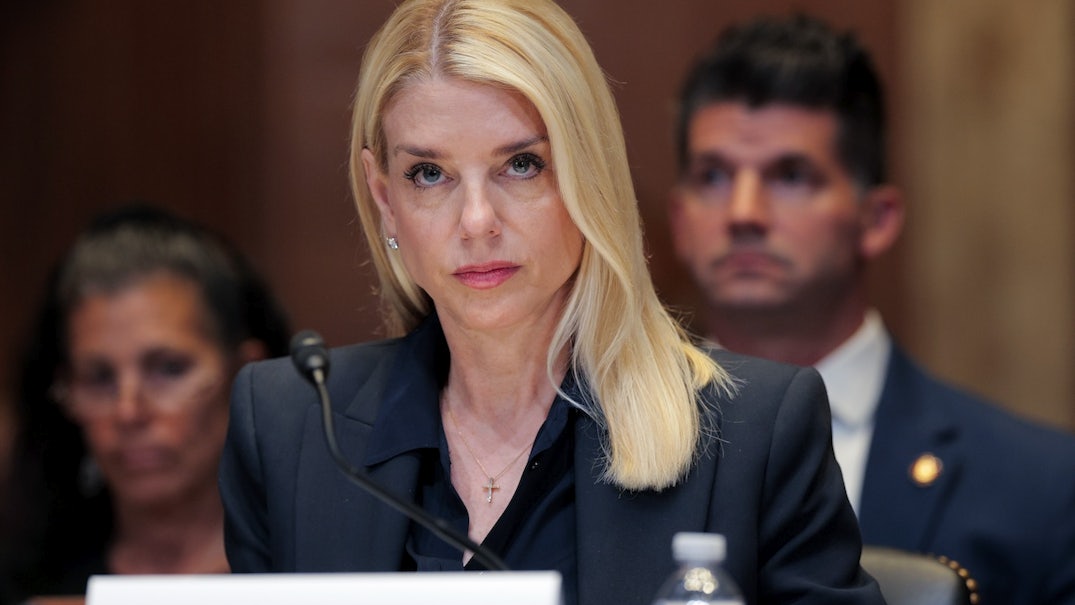
It’s time for the Pam Bondi intervention.
I doubt that any of the top political appointees at the Justice Department have the chops or guts necessary to tell the Attorney General that she’s fighting a losing cause with a series of doomed, Presidentially-decreed payback prosecutions. But she’d be well advised to heed the unmistakable message that has been sent by judges, grand juries, and DOJ alumni alike: the cases are failing and doomed to fail further, and she’s doing irreparable institutional harm to the Justice Department.
We’re familiar with the roll call of names President Donald Trump yearns to see on the other side of the “v.” in federal prosecutions brought by Bondi’s Justice Department. Former FBI Director James Comey and current New York Attorney General Letitia James have already been charged, and those cases have backfired, fast and hard (and predictably). Last month, a federal judge threw out both indictments because the Justice Department had improperly installed prosecutorial neophyte Lindsay Halligan as the U.S. Attorney for the Eastern District of Virginia. The joint dismissals were a sharp rebuke of the Justice Department – and then Bondi made it worse still.
Two weeks ago, DOJ tried to re-indict James, but a grand jury rejected the proposed indictment. Understand how rare it is for federal prosecutors to seek but fail to obtain an indictment. The process is completely one-sided, with a prosecutor and FBI agent presenting evidence but no defense lawyer or judge present; the burden of proof is mere “probable cause,” far lower than proof beyond a reasonable doubt; and prosecutors need the votes only of a majority of grand jurors, not unanimity as required in a trial setting. You’ve surely heard the “ham sandwich” maxim. I’m here to tell you that it’s true.
Undeterred and unenlightened, DOJ tried last week to re-re-indict James – and met the same result, with a different grand jury rejecting the case. (Fun fact: yesterday was the first Thursday since Thanksgiving when the Justice Department did not have a proposed James indictment rejected by a grand jury.) Bondi’s bumbling prosecutors can try yet again, if they’re gluttons for humiliation; unlike a trial acquittal, which bars a second prosecution based on double jeopardy principles, there’s no technical limit to the number of times prosecutors can ask grand juries to indict. But somebody needs to explain to Bondi that, as a practical matter, it’s over. It’s an embarrassment to get rejected by a grand jury once; it’s a mathematical near-impossibility to flame out twice. Enough is enough.
Even if DOJ succeeds in resuscitating the James or Comey indictments, fatal flaws abound. Both defendants have strong arguments for dismissal based on selective or vindictive prosecution. Comey has a compelling claim that the five-year statute of limitations has expired on his allegedly false testimony from September 30, 2020. And even if the Justice Department somehow clears those hurdles, then there’s the nontrivial matter of convincing a trial jury to convict, unanimously and beyond a reasonable doubt, on indictments featuring evidence that ranges from wafer-thin (James stood to make, at most, a few thousand dollars from her alleged mortgage fraud) to confounding (it’s not at all clear what exactly Comey testified to, never mind that he intentionally lied).
A spate of Trump’s other perceived political antagonists – Senator Adam Schiff, Federal Reserve Governor Lisa Cook, and former Special Counsel Jack Smith – are under federal investigation, at the President’s command, for various and hazy purported offenses. (The indictment of John Bolton is different; that investigation reportedly pre-dated the current Trump administration, and the charges of mishandling classified information seem serious and well-supported.) DOJ senior staffers would do themselves and Bondi a favor to convince her not to throw still more political sucker-punches at the occupants of Trump’s blacklist. How much more high-profile losing can the AG tolerate? How much more can the Justice Department take?
Even former Attorney General Bill Barr – the titular subject of my 2021 book Hatchet Man: How Bill Barr Broke the Prosecutor’s Code and Corrupted the Justice Department – had his limits. Despite public calls by Trump to prosecute Barack Obama, John Kerry, Hillary Clinton, and other prominent Democrats, Barr essentially ignored those fits of pique and let them tucker out. Bondi, by contrast, has hopped-to whenever called upon by the President.
Perhaps an intervention aimed at Bondi would be a bit misdirected. It’s plain, after all, that she’s largely carrying out the will of her boss. But she’s also a deeply experienced prosecutor with enormous power, broad discretion, and, ultimately, a Department to lead and a legacy to protect. Bondi isn’t some helpless ninny compelled by circumstances to act against her will. She’s the Attorney General of the United States.
Even if Bondi (or Trump) can’t be convinced that their abuse of the criminal justice process is wrongheaded, perhaps an appeal to raw politics will resonate. Indeed, we’ve seen meaningful cracks in the unified front of political supporters who typically insulate Trump. He’ll never lose his base, but he won’t always command unyielding fealty.
For example, four House Republicans this week defied Trump and forced a vote on the extension of Affordable Care Act subsidies. Earlier this month, Republican-led congressional committees demanded answers from the administration on a series of legally dubious bombings of Venezuelan drug boats. Last week, Indiana Republicans rejected Trump’s calls for mid-decade gerrymandering, evoking the President’s fury. In November, after just enough Republicans in Congress defied Trump’s efforts to suppress the Jeffrey Epstein files, the House and Senate overwhelmingly approved a bill requiring broad (if not quite complete) public disclosure. And a recent study by Marquette Law School shows that 55% of all respondents disapprove of the administration’s prosecutions of Trump’s political opponents – including 48% of Republican respondents, and 47% of independents. When nearly half of the President’s own political party thinks he’s out of line, it might be time to listen up.
I suspect that any effort to course-correct Bondi would end about the same as the Sopranos intervention: insults hurled, criss-crossing accusations of bad acts and bad faith, hands thrown, and little resolved or improved. But even Christopher Moltisanti eventually did get help (temporarily). And some effort at self-correction is preferable to resigned acceptance of a mad dash down the path of certain failure.


