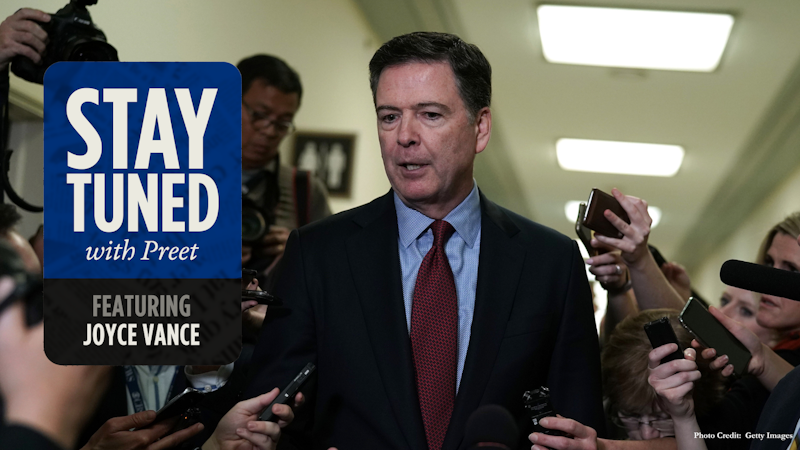







Preet Bharara:
From CAFE and the Vox Media Podcast Network, welcome to Stay Tuned. I’m Preet Bharara.
Dan Harris:
This is the most effective benevolent form of manipulation I’ve ever encountered. A little game I play during the course of my day is to see how many times I can get my interlocutor, the person I’m talking to say the word exactly because they feel heard. Once you’ve done that for people, they eat out of the palm of your hand.
Preet Bharara:
That’s Dan Harris. You might remember him as the ABC News anchor who had a panic attack on live TV, an experience that sent him down a very different path. He went on to write 10% Happier, which yielded a whole universe, a meditation app, podcast, and Substack newsletter of the same name. Dan joins me to discuss how small consistent habits can change your life, how best to avoid echo chambers, and how to navigate that one family member you fundamentally disagree with. Then I’ll answer your questions about what it’s like for prosecutors to see people they’ve convicted get pardoned. That’s coming up. Stay tuned. Hey folks, a reminder and an important one, our new Stay Tuned Merch Store is now open. Just in time for the holidays, you can grab your own Pled v. Pleaded T-shirt and other fan favorites like our signature stay tuned sweatshirt. Check all the items out at cafe.com/shop. That’s cafe.com/shop. 10% Happier founder, Dan Harris, shares his advice for all the meditation skeptics out there. Dan Harris, welcome to the show.
Dan Harris:
Great. Great to be with you.
Preet Bharara:
It’s good to have you. It’s been a while. We’ve been thinking about it, talking about it. We thought, what better time to have you on than right before the holidays in 2025? I gave some of this in the intro that was recorded, but to give listeners who are not familiar with you, I don’t know that there are that many who aren’t, can you give a sense of the arc of Dan Harris from news to this? Because it’s not normal.
Dan Harris:
No, it’s not.
Preet Bharara:
It’s not normal, Dan. Let us know your journey and maybe some of us want to take that same journey. I don’t know. Let us in on the deal.
Dan Harris:
Well, I recommend you do it the easier way. I’ve done it the hard way. I sometimes joke that some people teach from the mountaintop, I teach from the fetal position, so my arc has been bumpy. As you referenced, I was in the news business for a long time, 30 years. I started in local news in Maine and then I was in Boston for a while. Then in the year 2000, I joined ABC News and that was in the post 9/11 era. I spent a lot of time covering war zones and I was really kind of out there in it for a long time. And that resulted in some mental health challenges for me, including some drug dependency.
I was self-medicating with cocaine and other drugs, and that occasioned a panic attack on live television on Good Morning America in front of 5.019 million people. You can Google it. If you Google panic attack on television, it’s the number one result. My mother’s very proud of that. And that led me to meditation, so I wrote a book about that called 10% Happier, which Barbara Walters confidently told me I shouldn’t quit my day job and-
Preet Bharara:
Oh, how nice of her.
Dan Harris:
Yeah, she was amazing, but also very direct as a human. And that book got quite successful, ended up kind of swallowing my life. It turned into a podcast and more books and a meditation app and blah, blah, blah. And I ultimately did quit my day job and now I do this stuff full-time.
Preet Bharara:
May I say if it’s appropriate, we’ll run a podcast and it’s relevant, you have fully retained your news anchor, wonderful voice. Can you just do it for us? From ABC News.
Dan Harris:
From ABC News.
Preet Bharara:
Yes. See, there you go.
Dan Harris:
I can definitely do it, but it wasn’t a learned thing. I have a younger brother-
Preet Bharara:
You always sounded that way.
Dan Harris:
Yes. I have a younger brother who’s quite a prominent venture capitalist and he has the exact same voice. If he was here, you would not be able to tell the difference.
Preet Bharara:
Oh, that’s very interesting. Anyway, the voice comes in handy because eventually, notwithstanding the laws of entropy, or maybe this is consistent with the laws of entropy, we will all be podcasting. We will all be subsumed by AI in the simulation and be podcasting. Meditate on that, Dan Harris.
Dan Harris:
It’s hard to argue with that.
Preet Bharara:
A couple of questions about your approach to life and meditation and what compels you in that direction. And then I want to talk about how ordinary people can deal with the onslaught of news and stress and tension so they don’t get to the point that you got to. You help millions of people in that regard. 10% Happier. Why 10%? I’m more ambitious than that. That’s like a solid S&P 500 return. Why not 20%, 30%? What’s up with 10%?
Dan Harris:
I say the publishers of my first book, which by the way, nobody wanted to buy. Only one publisher bought it for very little money and they tried to bargain me up to 30% Happier. It’s kind of a joke, but I was very influenced in a kind of negative way. I was reacting against what I consider to be the reckless overpromising of the self-help industry writ large. And there are all these people telling you there are silver bullets and blah, blah, blah, and there are no silver bullets. What is available, and this is incredibly good news, is messy marginal improvement over time. And since you mentioned the S&P, I do think the 10% compounds annually so you, if you are ambitious, can exceed that 10% in quite dramatic ways.
Preet Bharara:
No, I totally agree with that. And maybe a question is, how do you get to that point where you understand and appreciate the compounding, the 10%, 5%, 3% small improvements in your life, often brought on by small habits. It’s like what Admiral McRaven writes about that a lot of people take to heart, just making your bed can be important and significant. How do you get into the mindset where you can go from the standard ideal in America, which is get rich quick, double your money, triple your money, get perfect abs in eight… Is it eight minutes or seven minutes? I can’t remember if it’s eight-minute abs from that Ben Stiller movie. To understanding and appreciating, you can make huge leaps and bounds and progress with your abs, with your portfolio, and with your mental health, with little incremental change. That’s not sexy, Dan. How do you make it work?
Dan Harris:
It’s not sexy. And there’s a reason why there are many people in my business of wellness or self-help or whatever you want to call it, who are way more successful than I am, but I’m not willing to lie to you. I mean, because it’s just not going to happen. And I spent many formative years covering self-help gurus who were just spouting bullshit and I can’t do it. How do you get to this point of being willing to, A, accept that you maybe need to make a change and B, accept that it’s not going to be overnight? I think one quite reliable route is suffering. I think if you pay attention to your… And this is not true for everybody. For many of us though, we have this kind of quotidian unhappiness, this background static of discontent. And when that becomes salient enough, then you get motivated. And when you try to do these miracle cures and find that they don’t work, that’s another form of suffering that can bring you to the mindset that I think is the one that can give you abiding progress, which is incremental.
Preet Bharara:
It takes patience though. Patience is a virtue as they say, but it’s a tough one. I’m always reminded of this old Jay Leno joke, which may be only I like and remember from 30 years ago. I’m home making a frozen pizza and the directions say heat at 400 degrees for 10 minutes. I’m like, screw it. I’m a man. I’m going to heat it at 4,000 degrees for one minute. Why doesn’t that work? And often when we talk about these subjects and I do on a not so irregular basis, I think about the frozen pizza. Why not? Because everybody wants that. They want the eight-minute abs. They want that. What’s the thing? I mean, I guess you sort of started to answer it, but usually when you talk to people, mentor people, counsel people, is it an epiphany that they get? I’m understanding the power of new habits and incrementalism, or is that itself something that happens slowly over time?
Dan Harris:
I think everybody’s path is different. And I deeply sympathize with the desire for rapid results. Patience is not one of my virtues, so I get it, but I can’t change the laws of physics, which we’re now referencing for the second time. One of the laws of physics is we will all become podcasters. The other is that the great news… By the way, my old job used to be to travel the world to bring you the worst possible news. My new job is to travel the world delivering one incredibly powerful piece of news, which is that the brain, and by extension, the mind are trainable, that your current levels of connection, calm, happiness, are not unalterable factory settings. They are in fact skills that are trainable.
That’s really good news, but we all come to that in our own way. And I do think one of the big paths, one is curiosity. Many people are just curious. Others are optimizers who just want to get better all the time. And I think that’s something I see in myself. And then a third is, as reference, suffering. You just bang your head up against the wall enough times, you will either get a concussion or you will see that this is stupid, I should stop doing it.
Preet Bharara:
Is the key, or maybe it’s both of these things, to find things that make you happy, touch grass, have a hobby, spend time with loved ones, or to remove things that bring you pain like negative people, a job that you hate? Is there a way to think about, in your experience, which of those courses, and I’m sure you’re going to say both, but which is more likely to lead you to 10% happiness? Is it the removal of bad stuff or the introduction of good stuff?
Dan Harris:
Yes, both, but I am actually personally more inclined toward the addition of positive stuff. But with the caveat that we’re all very busy and habit formation for humans is very difficult, so you want to do it small. You want to start small. All of the evidence around habit formation, and we’re coming up on New Year’s and people are going to be making their resolutions. Statistically, the vast majority of us will have bailed on those resolutions by February, so what does the research say? It says, start small, be very specific. What’s on the menu of positive additions to your life? I think about seven or eight entries in what I call the pantheon of no-brainers. Meditation’s in there for sure, but also, of course, exercise, healthy eating with the asterisk that you should still eat cookies. We don’t want to be… There is such a thing as orthorexia, which is the unhealthy obsession.
Preet Bharara:
Thank goodness.
Dan Harris:
Unhealthy obsession with getting healthy, and that’s sort of a pandemic in our culture right now, but so healthy eating with the asterisk.
Preet Bharara:
You know what disease I don’t have? I don’t have that one.
Dan Harris:
Well, we’ll diagnose-
Preet Bharara:
The obsession with eating healthy.
Dan Harris:
We will diagnose your specific disease coming up, but just to finish the list, sleep, therapy if you need it, medication if you need it. And this is an evidence-based assertion I’m about to make to you. The most important item on the list is not sleep or exercise or diet, all of which are important, but the most important is the quality of your relationships. The data are very clear that if you want to live forever, everybody’s obsessed with longevity right now, despite another law of physics that all systems tend toward entropy. The root to a long and healthy and happy and successful life is the quality of your relationship, so if you want to optimize anything, it’s that.
Preet Bharara:
I agree with that. And I consider that my greatest riches are my relationships, my family, friends. And a statistic, I don’t remember the exact statistic, you might remember it, but it really threw me. And it’s something like some vast percentage of men and women, and in particular men, will have made their best friend and no additional very close friends by the time they’re 20 or 18 or something, very young like that. And the likelihood in your life, once you graduate from school, once you get married and you start a family, that you will develop close personal friendships with new people is very low. I’m very fortunate and gratified that I go against the grain on that. I make new friends well into my fifties and very close good friends, and that’s sustaining. What are people supposed to do? Is there a hinge for friendships?
Dan Harris:
This is a huge issue, a huge issue. First of all, just to say I’m like you, I make close friends all the time and I don’t have to knock other people out. I met a kid when I was two and he was two, Larry Kalis, and we’re still very close, so I consider the crown jewels and my personal happiness to be the quality of my relationships. And we live in a lonely, tech obsessed, individualistic culture. And many people, when they hear, as is said in every Ted Talk, “We’re social animals, this is the key to our happiness.” They think, “Well, how do I do that?”
One great, great way to do it is to volunteer. Volunteering puts you… First of all, it reminds you of your innate nobility because it puts you in a position of helping out, which we are wired to do as a species. And the second thing is it inexorably puts you in contact with other human beings who, by the way, share your values, so if you’re looking for one, and I have more I can say on this, but if you were looking for one quick hack to meet new people, it’s volunteer.
Preet Bharara:
And that can be done anytime in life. It can be done when you’re a teenager. It can be done when you’re in your 70s.
Dan Harris:
Absolutely.
Preet Bharara:
I’ll make a bigger picture point. And this people say a lot, and that is understanding gratitude and being grateful which is a state of mind. Now, I have a particular reason, as do you, to be grateful. I have a great life, I have a great family, I’ve had great success, I represent clients who I want to represent. I’m on the righteous side of a lot of things. I’m rich beyond measure, but you have bad days and sometimes you get frustrated and you get annoyed and you have stressful days, even if you’re successful. The most successful people in the world have terrible days and some of them are driven to bad behavior, alcoholism and drug addiction. You were very successful and you reach a wall and you just have to… In my case, from time to time, I have to have an attitude adjustment and remind myself how fortunate I am.
Dan Harris:
Yes.
Preet Bharara:
And even people who are not as fortunate are pretty fortunate. And I don’t mean to denigrate people who’ve had tough lives and loss, we can talk about that too. But if you have a life like I have, I guess the question I have as I tell my story is, am I allowed to be irritated? Am I allowed to go to bed grumpy-
Dan Harris:
Yes.
Preet Bharara:
… even though I have a great life that a lot of people would give anything for? And I remember not that long ago, it was like two years ago, and I was complaining and whining about something to my wife about the podcast. Don’t tell the Vox Media people that I ever complained about the podcast. And she said something like, “Who did you interview yesterday on the podcast?” And I said, “That was Steven Van Zandt of the E Street Band.” And she’s kind of looking at me as if to say like, “You got paid to interview Steven Van Zandt. That’s a job that you have? You need to shut up.”
And I took it the way it was intended in a sort of self-help way. Is it okay? Because I sometimes feel guilty when I think I’m having a bad day, it’s still a pretty good day. Even if the interview with Steven Van Zandt had not gone well, it’s a pretty good day. I’m getting to interview you. This is super fun and it’s a job that I get paid to do. What is the allowance you give, Dan, for people who have things pretty good to complain and be unhappy briefly?
Dan Harris:
I give a ton of allowance for that.
Preet Bharara:
Oh, good. I love you already.
Dan Harris:
No matter how wealthy you are, you are, and we keep coming back to this. It’s probably my fault by this point, you are still subject to the laws of physics. You and everybody you know will die. You and everybody you know will get sick. Nobody is exempt from this. And so you’re going to have bad days and that’s okay. I do think for wealthy people, for successful people, what Spider-Man’s uncle said, “With great power comes great responsibility.” This is a thing I talk about with my son who turned 11 today. That is true. But all the more reason to wrestle with and reckon with your stuff, whatever it is that’s making you irritable so that you can be more useful to more people. Yes, you’re allowed to have bad days and yes, gratitude is incredibly helpful, except for the toxic variety that forces you to overlook misfortunes or traumas, but we’re not talking about that here, but all in the service of service, I think.
Preet Bharara:
Okay, so here’s another issue that comes up that I get asked about all the time because we cover news and a lot of it is not great. We’re recording this on Monday morning, December 15th and boy, it was a fricking terrible weekend, Dan.
Dan Harris:
Yeah.
Preet Bharara:
You have the shooting at Brown, you have the shooting of 16, I don’t know if I’m sure if they’re all Jewish, but the intended victims were Jewish in Australia. And then just when I thought that’s the end of the awful news for the weekend, find out Rob Reiner, one of my favorite directors of all time and his wife stabbed to death in their home. That’s some terrible stuff. And in the same way that I ask sort of, is it okay if you have a good life? Is it okay to feel frustrated and upset and unhappy from time to time? Is it okay to have joy and mirth when there’s so much bad stuff going on? My wife and I talked about this last night, and I know you have an answer to that, so I want to hear that answer. Then I want to talk about some other things about how people can deal with the news in a way that educates them and enriches them, but doesn’t defeat them.
Dan Harris:
Well, I have a very close friend whose daughter who I’m also close with was at Brown and my friend had to drive up and get her. And as somebody who had a Bar Mitzvah, the news out of Australia is incredibly disturbing. Even you don’t have to be Jewish to be disturbed, obviously. And of course, Rob Reiner, that dude did Spinal Tap, a giant. And so what happened to him is grotesque and awful. And we need joy, mirth, happiness. A lot of people feel guilty about being happy at a time when this country might be in an autocratic slide and when people who are US citizens are being snatched up on the street.
And I get that, but we need happiness in order, and this comes right back to what I said at the end of my last answer, to be useful, to be positive, constructive players in this environment. It is geopolitically important for everybody to have an IV drip of joy in their lives that doesn’t force you to overlook or deny the truth of what’s happening in the world, but allows you to respond more effectively.
Preet Bharara:
I’ll be right back with Dan Harris after this. Here’s a conundrum, and I’m guilty of maybe overlooking the fact of the conundrum a little bit. We complain all the time. I complain all the time, that American society is very siloed, that people listen to voices who agree with them, that they are in an echo chamber. And if you’re on one side of the spectrum, you watch Fox News and it agrees with all your points of view, and otherwise MS NOW, I think it’s called now, on the other end of the spectrum. And people just get reinforced in their views and they don’t challenge their views or their positions. And we’re not talking about politicians, we’re not talking about podcasters, we’re not talking about newscasters, we’re talking about ordinary people who are good citizens. Let’s talk about the category of people who are good citizens who care about the world or care about their community, like I think most of our, if not all of our listeners are, but they’re also seeking peace of mind.
And if not joy, then some measure of stability and lack of anxiety permeating their being. And to listen to a voice that is discordant with yours, particularly if you think it’s in bad faith and bad for the country, as opposed to just a difference of opinion on what the best opening gambit in a chess game is, that’s somewhat frivolous, that causes stress and unhappiness. And so I find myself thinking that we’re in a bit of a quandary when we hear people lecture folks, “You need to watch Fox, you need to listen to complete assholes who are bringing America down in your good faith view at the same time saying you should maintain your sanity.” How do you square those things?
Dan Harris:
Well, I think it’s a really well posed question. I’ll tell you how I’ve solved it for myself because I am of the view that good citizenship does involve in good faith reckoning with the views of our fellow citizens that the views that we may find unacceptable or unpleasant. As Ian Bremmer, a foreign affairs expert who I admire once tweeted, “If you’re only following people you agree with, you’re using this website incorrectly.” And so I really do agree with that. And I agree with your point that watching Fox News competes with the point I was making earlier about how we need to have some happiness and joy in our lives in order to navigate these tumultuous times effectively. Here’s how I’ve solved this for myself. I do not watch Fox News. I do not listen to Steve Bannon’s podcast. I don’t listen to Tucker Carlson or Candace Owens. What I do do is I’ll state my priors here. I was, as referenced earlier, a news anchor for 30 years, but I was raised in the People’s Republic of Massachusetts. Everybody of a certain age knows where they were when there was a moon landing.
My mother was at a Black Panther rally, so that’s what I come from. And so I would say I’ve netted out after all of these years of spending a lot of time with people on the far right as a journalist. I’ve netted out as kind of center left. That’s my kind of priors, but I’m journalistically trained and so am inclined to listen to people across the spectrum, so what do I do? I find people on the center right, so I listen to the commentary podcast, the editors from the National Review. I read Andrew Sullivan on Substack. I listen to Ben Shapiro on occasion. Ben can be a little challenging for me because he’s more pro Trump than the others that I just listed. I listen to the Commentary podcast, people who I think are smart, well-intentioned, but I often disagree with. And look, some days I click on over to The Daily or Morning Joe or whatever it is because I want to have my priors confirmed, but I do regularly push the envelope to the extent that I can handle it.
Preet Bharara:
That makes a lot of sense. Find some, but not too many… Did you go through a period of time when you were transitioning away from news, abandoning the news altogether, and did you slowly come back to it? Or did you always maintain a foot in the world of news junkiehood?
Dan Harris:
I don’t know how interesting this will be to people, but I was actually never a news junkie. I was an experienced junkie. My favorite part of being a news man was, or news person was… I’ve been all over the… It’s hard to find a place I haven’t been and not as a tourist. I’ve been there and I’ve integrated into the local culture and I’ve spent a lot of time, a lot of time in my life as the only white person in various environments in Africa and the Middle East and Asia and in South America. I’ve lived with indigenous tribes and the Amazon twice for extended periods of time. And so that was really the thing that was motivating for me, so when I got out of the news business, one of the biggest sources of relief was that I didn’t have to be read in on every single story. And so I’ve had moments where I’ve been a low information voter, but I’m very interested in/concerned by and often horrified by what’s happening in our politics now. And I really do keep up with that.
Preet Bharara:
Here’s a variation on the question/dilemma of being siloed with respect to the news. Some things you can shut off. You can decide to skip a particular channel, not watch a particular YouTube commentator, but people have friends and family. We talked about the importance of relationships. I wonder how that intersects with what I’m about to ask. Man, what is the degree to which in current modern society, if you in good faith have a set of values and beliefs about the country, the Constitution, people, society, the rule of law, all of those things, and then you have a member of your family who you’re going to spend time with over Christmas or the holidays who has some differing views and they’re not marginally different, they’re anathema to you?
And if it was a person who lived on your block, you wouldn’t talk to them very much. And we can talk about whether or not that’s a smart idea and that’s a good idea for America or not, or for people’s sanity or not. But what is the leeway that you give people if the question is, and there’s two questions, what is good for one’s own happiness and what is good for the public, for the country? Sometimes those two things are at odds with each other, but answer either one. What does your experience tell you and advice you give about that question? Is blood thicker than differences of political opinion or not?
Dan Harris:
My sense on this, first of all, it’s incredibly challenging, so if you’re in this situation, I’m sorry. It’s a very individual decision depending on your nervous system. I do think it is okay if you’ve really thought about it to draw a hard boundary and decide that somebody is too traumatizing for you, whether it’s in your family or your neighbor. I get it. Having said that, if you think you’re up for it, I do think engagement in the right way can be very fruitful, so what’s the right way? I don’t know if you’ve ever heard of this group, the Braver Angels. They’re very interesting. They’ve been around for a decade or so, and I spent some time after Trump’s first election going to one of their first national conventions. Basically what they do is they bring political odd couples from across the country together, reds and blues. And they have a system for these kind of encounter sessions that are very structured. The structure was created by a marriage counselor, which I think is really interesting because he knows how to bring people together who disagree.
And one of the rules is never try to talk somebody out of their opinion. He says, the goal is not to change somebody’s mind, which is almost impossible and usually where things go pear shaped in these conversations. Instead, the goal is to reach what he calls accurate disagreement. And so how do you do that? When you’re in a conversation with your proverbial, in this case, truly proverbial obnoxious uncle, I hope that not everybody has an actual obnoxious uncle, one trick that I have found very effective is something called reflective listening. Your uncles going on about all the benefits of tariffs and instead of listening or doing what I’ve, and I love this term, doing what’s called predatory listening, where you’re just listening to find the weak spots in his argument so that you can dunk on them, you listen actually to report back journalistically what you’ve heard so that you understand his point.
Oh, so you’re saying you think ultimately tariffs are a really effective use of power geopolitically, whatever it is. You’re delivering the bones of his message back to him in headline form. And this is the most effective benevolent form of manipulation I’ve ever encountered. A little game I play during the course of my day is to see how many times I can get my interlocutor, the person I’m talking to, to say the word exactly because they feel heard. Once you’ve done that for people, they eat out of the palm of your hand. And so I would play this game over the holidays with the people you disagree with. If you can stand and if you think you can responsibly to your own nervous system, tolerate them, see if you can make them feel heard. And then by the way, they might be willing to hear you.
Preet Bharara:
I mean, you refer to it as a game. I know you don’t mean that. It’s an exercise of respect.
Dan Harris:
Yes.
Preet Bharara:
And it also is… I’ve made the point in multiple places that even though my profession, my main profession, which is practicing law, litigation and law in the courtroom, it’s much maligned. There’s some good features of it. You’re not allowed to, and you wouldn’t long be a good member in standing and you would have no clients, if when the defense was going, if you’re the prosecutor or the plaintiff, you stuck your fingers in your ears and you said, “Nah, nah, nah, nah, nah,” and didn’t listen. You also can’t in a court of law presided over by a reasonable judge, fearmonger, discriminate, call people from certain places, residents of shit-hole countries. You can’t do any of that. You have to make all your arguments reasonably as a requirement of the enterprise, which is to get to the truth and to accountability.
And you have to listen to the other side. And you have to, when you’re rebutting forcefully the other side, which is what that exercise is, I mean, more forcefully than you do on cable television, I think, because there’s stakes. It’s not just talk. There are things at stake, liberty and financial considerations. You have to accurately state the position of your opponent and then attack it. This is my very, very occasional exaltation of the law and legal argument as a model for how we should deal with these things in real life too.
Dan Harris:
Yes. Which is why, and I’d be interested to hear your views on this, this is why I worry so much about what appears to me at least to be the undermining of the rule of law.
Preet Bharara:
Yeah. But the problem is, so in a court of law, presuming you have a reasonable judge, and I think most judges, overwhelming majority judges are reasonable, if one side does it, they get cut down and the other side does it, they get cut down and that makes you look bad in front of the jury. It makes you look bad to the judge. You might not get rulings in your favor with the same frequency, if you start engaging in cable news BS. But in the unregulated wild of public square debate where people can lie with impunity, people are not prepared to do follow-ups, there is no adjudicated, there’s no arbiter, there’s no judge to say that’s out of line.
As much as your former profession talks about trying to do real-time fact checking, it doesn’t really work. It’s very hard to be the one… When they go low, we go what? And so if you’re dealing with a bad faith arguer on one side, what do you do? Where do you go? Maybe those are the people you have to disengage with and the exercise you talked about. First of all, separate and apart from everything you said, and I think you hinted at this, it helps you understand your position better too.
Dan Harris:
Yes.
Preet Bharara:
In this whole debate, I think this every single time I hear people say, and I talk about this all the time, “Trump is weaponizing the Justice Department. He is trying to put his political adversaries in prison. The things he’s doing with people who I represent and other people represent are an abomination.” But I’m very aware when I say these things and when I hear other people say these things, that in the ears of the MAGA folks, they’re like, “That is rich because that’s what you did to our guy.”
Dan Harris:
Yes.
Preet Bharara:
Now, there are differences, enormous differences, huge differences, dispositive differences that get aligned in this lack of, I think, honest debate. But what Blinks read to me is when I think of the average MAGA voter, they just tune out all this stuff about weaponization because your guys indicted my guy four times, and it was all BS. And you have to be aware of that. I don’t know where I’m going with this point, but it makes you, I think hopefully, a little bit more careful about the arguments you make and draw better and smarter good faith distinctions between the arguments you might make if you had no understanding of the mindset of the opposition. And you must have an understanding of the mindset of the opposition if you’re going to do your job, fair?
Dan Harris:
Absolutely. What would you say if somebody over the holidays has decided, let me see if I can constructively engage with my MAGA uncle, because I’m picking on uncles here, but-
Preet Bharara:
There’s some MAGA aunts too.
Dan Harris:
Yeah, no, I know. There are plenty. If you’re engaging with somebody in your family who you disagree with on this stuff, and they make that point that you just said, what is a not too complicated way to differentiate between the current weaponization and our view of the DOJ vis-a-vis the four indictments of Trump?
Preet Bharara:
It becomes difficult because it’s not as simple. It’s very easy to slogan here and say, “You guys did that to us. Now we’re going to do it to you and how can you complain about it?” Because the us and the they are not so clear. What happened to Trump is in four separate places with three different sets of prosecutors, two of them local, went through a proper process, were not commanded by the commander-in-chief, and any evidence to the contrary doesn’t exist. Or my favorite is when the Trump folks, the MAGA folks say, “The absence of evidence that Joe Biden directed all these prosecutions is in fact evidence because they’re so good at covering up.” It’s the crazy argument that the presence of evidence and also the absence of evidence proves my point that you wouldn’t get away within a court of law. And they followed proper process and the grand jury in the case of the Manhattan case, which lots of people on the left criticized. I didn’t think it was the most perfect case in the world.
There was a trial, there was a jury, I guess the appeal I think may still be ongoing, by an independent prosecutor who, by the way, had decided with respect to another set of proposed charges against Donald Trump not to bring those charges. And you can argue, as the day is long, that they were not properly brought or there were good faith reasons not to bring those charges, but they were not directed by the commander-in-chief. Same in Georgia with respect to the federal prosecutor, Jack Smith. Again, there’s one reference somewhere by an anonymous source in an Axios or a political article, which is what the MAGA folks, as I understand it, because I listened to some of what they say, point to as evidence this was orchestrated by Joe Biden. Joe Biden, by the way, who yes, at the end of the day, pardoned his son, but permitted his Justice Department to have a special counsel investigate his son, permitted all sorts of things that he could have done otherwise on.
And it turns out that those cases were brought and they were brought in, I think, in good faith compared to what Donald Trump is doing, which is with respect to Tish James, who I do not represent, has an improperly appointed United States attorney whose appointment has been found to be inappropriate, dismisses the charges. They go to one grand jury and you’re supposed to be able to indict a ham sandwich, fail. You go to another grand jury, fail. Before all of that, you had the career people led by a political person who you, Donald Trump, appointed yourself who said and wrote, “This is not an okay case to proceed with. There is not sufficient evidence. It’s not proper. It’s not just.” You have a million pieces of evidence that the sitting President of the United States himself is orchestrating and directing the wholesale persecution and potential imprisonment of political adversaries. That’s a totally different fucking thing. But it takes me five minutes to say all that. And I don’t know that it’ll be convincing to anybody because on the other side, but there it is.
Dan Harris:
Well, so a short version of that might be… That was excellent, I thought. Look, if somebody says, “Hey, you guys indicted Trump four times. Why are you so exercised about what’s happening now?” I hear you on the indictments of Trump. However, in my view, is it kind of a different kettle of fish that the prosecutors went through the proper channels, followed the correct processes, and were not operating on orders from the White House, so that’s a very different situation.
Preet Bharara:
I mean, the way they get around that is the point I made that, well, of course you don’t see evidence of it. You don’t see evidence of it, which is by the way, an interesting admission it seems that Sleepy Joe, who was not competent to be president, was more clever than Donald Trump, who just tweets his instructions accidentally about who he wants prosecuted and on what terms, and people should go to the electric chair for stating correct versions of whether or not unlawful orders in the military should be followed or not. I mean, it’s just crazy talk. I don’t want to leave the podcast without giving you an opportunity to talk about meditation. I have not ever meditated. Talk to someone like me who I think I can say about myself, I care about being healthy. I care about having good mental health, good physical health. I have a lot of stresses in my life, even though as I said, I’m very fortunate. Talk to me about why someone like me and many, many listeners that we have should think about that.
Dan Harris:
Well, just to be clear, I am not like a meditation fundamentalist. I think you can lead a very happy life without meditating. And so to me, as I talk to you that, and we’ve met before and my overarching impression is you’re a happy guy, so if you don’t feel some burning need for it, then go with God. However, I do think there’s a very compelling case to be made from meditation writ large. It really is a way to train your brain and mind to do at least two things. One is to be more focused, so this is why you see the practice being adopted by elite athletes and CEOs who want to be able to have their mind not so yanked around by everything that’s besieging us in this info blitzkrieg through which we are living.
The second and I think more important benefit is it allows you to be not so yanked around by all of your thoughts and emotions so that you can have a different relationship to the ancient neuroses and grudges and storylines and emotional patterns and habits that you inherited from your parents and from the culture. And that kind of emotional agility can be incredibly valuable. And again, is why you’re seeing uptake on meditation in so many interesting parts of our culture, so very compelling, lots of science to support it, and many other levers to pull if you’re looking to improve your life.
Preet Bharara:
How has it improved your life beyond the ways you’ve just mentioned?
Dan Harris:
Over time, massively, because I am, as I said before, I am so wired for anger and anxiety. It’s really just helped me not be so owned by the stuff that was making me unhappy. I had such a stressful job being in the news media. I was anchoring several shows at ABC News and covering all the big stories from mass casualty events to natural disasters to war. And so I’m less… I’ve kind of cut the strings of the malevolent puppeteer of ego. That doesn’t mean I’m perfect.
Preet Bharara:
Wow, that’s a good phrase.
Dan Harris:
I heard the CEO of my company say recently, “Dan practices what he preaches about 70% of the time,” which I will take. That’s great.
Preet Bharara:
That’s pretty good.
Dan Harris:
Yes.
Preet Bharara:
That’s pretty good.
Dan Harris:
But I want to be clear, I have my bad days and that’s absolutely fine. There are fewer and I apologize more quickly and it has been just incredibly helpful in that way. And just to reemphasize this, there are lots of ways to get there.
Preet Bharara:
I will confess because I’m feeling confessional. You could say on the one hand, not knowing me very well, “Well, you don’t need meditation. You’re pretty happy, balanced guy.” And I think for the most part I am. But the great fear that I have, the worst experience I can, and I’m just going to say it, and I’m not alone, is the absence of stimuli, the absence of stimulation from other sources. I’m a guy, I can be on three screens and reading something and responding to five different people, and I like that, and that gets me where I’m going, and I’ve always been that way. I can’t fully relax on vacation. I don’t know when that happened in my life when I stopped being as lazy as I used to be when I was young.
And one of the most miserable things that I can experience, and I just want to be honest, know your reaction, is to be by myself in a dark room with no phone, no book, no reading with my… And I had to do that once because I had to have a procedure a year or two ago, and in advance of the thing that I had to get, I had to sit in a quiet darkened room. And I was also told, and here’s the kicker, I’m like, “Oh, this is great. I’m always sleep-deprived.” And you can’t sleep because the kind of scan it was, for whatever reason, it skews the result if you’ve entered a dream state before they do the scan, so alone, no stimuli, no phone, no clock, no conversation, no TV, no screen, no sleep, and I was beside myself. That’s a problem, isn’t it?
Dan Harris:
Well, I appreciate you saying that, and I want to normalize it and validate it. I relate to what you’re saying, and I believe there was a study, I might be mangling the results somewhat, but there was a study that gave people the option, “Would you rather sit alone in a room with your thoughts or receive an electric shock?” And the majority chose the electric shock.
Preet Bharara:
I am so down with you. I mean, how many volts?
Dan Harris:
I don’t know the details of the voltage, but suffice it to say an unpleasant electric shock.
Preet Bharara:
I’m willing to concede that that’s crazy. That’s a crazy thing. There’s this thing that people talk about now and they apply a term that I think, although I’ve already cursed once, my father is going to tell me about it, on a flight where people will brag on social media that they didn’t use a phone, they didn’t watch a TV, they didn’t watch any screens, they didn’t talk to anybody, they use a term-
Dan Harris:
Raw dogging. Raw dogging.
Preet Bharara:
Yes. I don’t know. Can you say raw dog on a family show?
Dan Harris:
Bleep me.
Preet Bharara:
I think you can. That sounds like torture to me, so I’m willing to concede that there’s something wrong with my psyche that the most basic way of existing for tens of thousands of years before we had all this stimuli is something that I not only am scared of, but never, ever do. And am I the worst for it or am I okay?
Dan Harris:
First of all, there’s nothing wrong with you. This is a reaction, a natural, rational reaction to the environment in which you find yourself. I’ll just speak for myself. I am better off for the ability to do what scares you and I find it scary. And I certainly did when I was starting 16 years ago and starting to meditate, but you start real small with one minute, I started with five minutes where what makes it less scary is it’s not just throw open the door and sit there with nothing to do, which is what these kids are doing on flights and putting on social media. You’re being in the moment, to use the cliche, in a very specific way. You’re trying to, for a few nanoseconds at a time, focus your mind on usually on the feeling of your breath coming in and going out and you’re not breathing in any special way, you’re just noticing the breath as it comes and goes. And then you will get distracted a million times. And a lot of people in those moments of distraction tell themselves a whole story about how they’re somehow dysfunctional.
But no, the waking up from distraction is not proof of failure, it’s proof of success because what you want over and over and over in this practice is to try to focus on something, get distracted, start again, get distracted, start again. And this is like a bicep curl for your brain. It changes the part of the brain associated with attention regulation, which has atrophied in our current environment, and it changes the part of the brain associated with self-awareness because every time you wake up from distraction, you’re getting familiar with how wild your mind is. And that allows you in the rest of your life when you’re bombarded by a blast of anger or when you have this desire to say something that’s going to ruin the next 48 hours of your marriage or whatever it is to not be so owned by it. And that is a game changing skill.
What I’m proposing and what the Buddha 2,600 years ago in Northern India was proposing was not that you just sit there in a darkened room with nothing to do with your mind, but that you give your mind a task that has a simple task that has radical implications.
Preet Bharara:
I will think about it. Final point on laughter, I love to talk about it. And I had a conversation recently with a great guest about laughter versus smiling. And you said something on another podcast recently about laughter, that among certain people, there’s an extraordinary capacity for laughter and for compassion. It’s like there’s less of a self there. There’s more available to respond to your needs and also they’re not taking themselves as seriously and so therefore they’re just kind of laughing at themselves. And, I mean, that I think is a real north star for me. Can you just talk about that for a minute? Because the people who I feel most sorry for are not necessarily those without means and wealth or even relationships, but who have no laughter in their life. I really mean that.
Dan Harris:
Yes, I agree with that. One of the things I’ve seen my job has become to spend time with the world’s great spiritual masters. I’ve had the Dalai Lama on my podcast many, many times and have been privileged to spend time in his orbit repeatedly. I’m also very close with a great meditation teacher named Joseph Goldstein, who’s less famous, but is an 81-year-old guy who’s been practicing meditation intensively for 60 years. And what you see when you’re around people like this is the common denominator is they have a great sense of humor. They laugh a lot because when you sit and look at your mind for extended periods of time, you see it’s ridiculous. You also see that-
Preet Bharara:
It is, isn’t it?
Dan Harris:
Yes, it’s… That word ridiculous is one of the most common words that Joseph Goldstein uses. And the other thing you see, and this is radical and may take a minute to sink in, and it may never sink in for some people. What we also see is that you’re not directing this show. To a certain extent you can force yourself to think about certain things, but most of what’s happening in the mind is uninvited, unbidden. You can’t control it. If you could control it, you’d be able to sit and focus on your breath in perpetuity, but you can’t because all of these crazy thoughts keep coming into your mind. You’re planning a homicide, you’re wondering about when your next bag of Doritos is going to happen, whatever.
Who’s doing all of that? You start to see that this you, this CEO of Preet that you think is some tiny, identifiable, homunculus between your ears or behind your eyes doesn’t exist. And once you sort of get over yourself in that way, there’s more room for everybody and everything else. And so you can laugh at the world, you can cry with people who are suffering. And you’re kind of like a more sophisticated toddler who moves through emotions quite quickly. But in this case, you’re moving through emotions in ways that are appropriate and spontaneous based on the context. And that’s what I’ve seen from hanging out with these amazing people.
Preet Bharara:
I got to hang out with the Dalai Lama. Maybe we can all do a thing. I’m available, Dan. Let the record reflect that you did not immediately jump at the opportunity.
Dan Harris:
The reason I didn’t jump at the opportunity is because he’s 87, maybe 88 now, and has really cut back on his public appearances. Otherwise, I would-
Preet Bharara:
But for that, he would be like, “Let’s hang out with Preet.” That I know. That was clear from your pause.
Dan Harris:
Why not?
Preet Bharara:
Dan Harris, great to have you on. Such a treat. Let’s do it again before too long and have a great, great, healthy, happy holiday.
Dan Harris:
You too. I love talking to you. Thank you.
Preet Bharara:
My conversation with Dan Harris continues for members of the CAFE Insider community. And the bonus for Insiders, Dan turns the tables and puts a pointed question to me about what gets in the way of my happiness. Much of life in appreciating things is about your orientation, right? And if you just think about something a different way, and it sounds very easy and it’s very glib for people like you and me to say it, but I’ll speak from experience. To try out the membership, head to cafe.com/insider. Again, that’s cafe.com/insider. Stay tuned. After the break, I’ll answer your questions about what it’s like for prosecutors to see people they’ve convicted be pardoned. Now let’s get to your questions. This question comes in an email from Teddy who writes, “What is the occupational and psychological fallout for prosecutors who worked tirelessly to secure convictions for serious crimes, only to have the President pardon the perpetrators?” Wow, Teddy, that’s a great question and not something that’s really discussed publicly very much.
And obviously there are a range of reactions and there are range of kinds of cases where presidents have pardon folks, most famously recently, I guess, the January 6th pardons, and I think the prosecutors were not too happy about that. As I’m sure you’re aware, federal prosecutors work extremely hard on their cases, sometimes for years, interviewing witnesses, reviewing evidence, preparing for trial, and when the trial finally comes to an end and a jury returns a guilty verdict, there’s a real sense that all of that work was worth it, that justice was done, the community is a little bit safer, but as can sometimes happen with the stroke of a pen, a presidential pardon can undo that work or at least undo the consequences of that work. And that can sometimes be difficult for prosecutors, even though most don’t talk publicly about the emotional toll it takes. Now, there are pardons and commutations that are supported by prosecutors.
When I was the United States Attorney in the Southern District, there was an initiative led by President Obama and Attorney General Eric Holder, where on minor drug infractions and other kinds of cases, prosecutors were asked to give their opinions, whether certain people should have their cases commuted. And in many cases, we agreed the passage of time, the change of priorities, the alleviation of the harshness of some of the penalties from the past, all of those things combined to support clemency, even in the hearts and minds of the prosecutors who were responsible for those convictions. Now, on the other hand, many presidents have issued controversial pardons, so it’s striking how rarely prosecutors describe what it feels like. I mean, I think in general, you do your job, you pursue those appropriately in the interests of justice, you get the conviction, the sentence occurs, and if as is his right under the Constitution, a President decides to pardon that person, it’s kind of not your problem. Now, if you go back to 1992, when President George H. W. Bush pardoned several people implicated in the Iran contra scandal, independent council Lawrence Walsh was unusually candid.
He said quote, “The Iran contra coverup has now been completed,” end quote. He also said quote, “It’s hard to find an adjective strong enough to characterize a president who has such contempt for honesty,” end quote so he didn’t mince any words. More recently, as I already mentioned, after President Trump issued mass pardons for people connected to the January 6th attack, the prosecutor who oversaw many of those cases, former Assistant US Attorney Greg Rosen was also outspoken. He said quote, “It sends a terrible message to the American people. Individuals who were duly and appropriately convicted of federal crimes ranging in culpability are immediately let loose without any supervision, without any remorse, without any rehabilitation to civil society. The message that sends is that political violence towards a political goal is acceptable in a modern Democratic society. That, from my perspective, is anathema to a constitutional republic,” end quote. Now, not all prosecutors feel the need to comment publicly. They have other options.
At the end of his presidency, you may recall, Bill Clinton issued a controversial pardon and rightfully seen as controversial for someone named Marc Rich, a fugitive who had been indicted for massive tax evasion, fraud, and illegal oil trading with Iran. Many believed the pardon was influenced by donations from Rich’s ex-wife to Democratic causes. That case was brought by my former office, the Southern District of New York. Now, the Rich case never went to trial because he fled the country, but Mary Jo White who was the US attorney at the time, and as I said, it was under her leadership that Marc Rich had been indicted. After the pardon, all she said publicly, I believe, was that the pardon had been granted quote, “Without consultation with her office,” end quote, and that she had no further comment, but she did have a lot to say after all through the work of the office. Mary Jo White continued on as US attorney for at least a year to the Bush administration.
And part of what was on her docket was the investigation of the pardon of Marc Rich into the president who had appointed her as US attorney. Now, as you may know, I’ve been in this situation myself. I was US attorney for seven and a half years and a number of people on whose indictment my name is written have been pardoned. I think I’ve only commented one time. It was in 2018 and I was working on the book, Doing Justice, and I decided I was just going to work, work, work all day, not take any meetings, not do any television appearances, not do any recordings for the podcast that was still a fledgling at the time, and then the news broke that President Trump had pardoned Dinesh D’Souza. I have a lot of things to say about Dinesh D’Souza, but I’ll keep those to myself for the moment. Trump said in a tweet that D’Souza had been treated very unfairly by our government. I begged to differ. I was invited on television to appear on CNN with Dinesh D’Souza, an opportunity that I declined.
But as the day wore on, I found myself not able to concentrate on the book I was writing, and I got a lot of incoming, and there was a lot of false information out there about the nature of Dinesh D’Souza’s case, so I posted the following on Twitter quote, “The President has the right to pardon, but the facts are these. D’Souza intentionally broke the law, voluntarily pled guilty, apologized for his conduct, and the judge found no unfairness. The career prosecutors and agents did their job, period,” end quote. In the D’Souza case, it wasn’t even like some of the others where people went to trial. D’Souza did not even maintain his innocence. He pled guilty and apologized. In any event, as you can see, different prosecutors react to pardons in different ways. Some have spoken out forcefully, others stay silent.
I think both reactions are appropriate and I think are personal to the prosecutors who are involved in the particular cases, but with three years left in President Trump’s second term, I think we can expect more questionable or controversial pardons coming our way, and I’m sure we’ll be discussing some of them on the show also. Stay tuned. This question comes via a post on X from Vance in LA, “Does a presidential pardon absolve a military crime?” Thanks for that question. I’m assuming you’re asking this in light of the recent reporting about the so called double tap US strike on a disabled vessel near Venezuela that killed two people on board. And as we’ve discussed many times in the podcast, and I’m sure you’re aware, the President of the United States can only pardon folks for federal crimes, not state crimes. And so it’s a reasonable question, well, what about the category of military crimes? The short answer is yes, for the most part a presidential pardon can be used for military crimes.
You go back to Article two of the Constitution in which the president has the power to grant pardons for quote, “offenses against the United States,” end quote. Courts have long interpreted that phrase to include violations of the Uniform Code of Military Justice or UCMJ, which is the body of federal law that governs courts-martial, so if a service member is convicted under the UCMJ, the president has the power to issue a pardon or commute the sentence. One of the best known historical examples is the case of Lieutenant William Calley. On March 16th, 1968, Calley lit a platoon involved in the My Lai Massacre, where American soldiers killed hundreds of unarmed South Vietnamese civilians. After the massacre was revealed to the public, Calley was court-martialed and in 1971, convicted of the premeditated murder of at least 22 civilians, and he was sentenced to life in prison. But after intense public pressure, President Richard Nixon intervened. He didn’t pardon Calley outright, but he commuted his sentence, reducing it from life in prison to house arrest. Calley ultimately served about three and a half years before being paroled.
In his first term, President Trump issued several pardons or clemency actions and military related cases. The one that he did that drew the most attention was of Navy SEAL, Eddie Gallagher. Gallagher had been convicted at court-martial of posing for a photo with a dead detainee’s body. More recently, President Trump issued pardons or granted clemency to several service members convicted of misconduct on the battlefield, including cases involving unlawful killings. Those pardons were actually widely criticized by military leaders themselves, who argued they undermined discipline and the laws of war, but those pardons were not unlawful. There are some limits to keep in mind. A presidential pardon applies only to criminal offenses, not to administrative or disciplinary actions within the military, so a pardon does not automatically erase things like disciplinary reprimands, demotions, or discharge decisions. In other words, just to go back to your question, the president can pardon the criminal offense, but the military can still impose non-criminal consequences based on the underlying conduct. Well, that’s it for this episode of Stay Tuned. Thanks again to my guest, Dan Harris.
If you like what we do, rate and review the show on Apple Podcasts or wherever you listen. Every positive review helps new listeners find the show. Send me your questions about news, politics, and justice. You can reach me on Twitter or bluesky@preetbharara with the hashtag AskPreet. You can also call and leave me a message at 833-997-7338. That’s 833-99-PREET, or you can send an email to letters@cafe.com. Stay Tuned is now on Substack. Head to staytuned.substack.com to watch live streams, get updates about new podcast episodes and more. That’s staytuned.substack.com. Stay Tuned is presented by CAFE and the Vox Media Podcast Network. The executive producer is Tamara Sepper. The technical director is David Tatasciore. The deputy editor is Celine Rohr. The supervising producer is Jake Kaplan. The lead editorial producer is Jennifer Indig.
The associate producer is Claudia Hernandez. The video producer is Nat Weiner. The senior audio producer is Matthew Billy. And the marketing manager is Leanna Greenway. Our music is by Andrew Dost. Special thanks to Torrey Paquette and Adam Harris. I’m your host, Preet Bharara. As always, stay tuned.